Crossref has supported and participated in the 3rd Diamond OA Summit in Bengaluru last month. The Summit was building upon two previous events, where this community gathered to collaborate to increase the momentum and scale of this fee-free publishing model:

In Bengaluru, the key focus was on Collaboration for Equitable Digital Infrastructures and Knowledge Commons in Agriculture and Broader Scientific Research Systems, and the key objective of the gathering was to draft a multi-stakeholder roadmap to further the movement.
It was an inspiring opportunity to meet with the community so set on refocusing the research enterprise on public good, as well as meet in person with members and partners from many corners of the world.
On a personal level (and I know it is true for many other delegates as we reflected about it over breaks together), the Diamond OA Summit is a significantly different experience: utmost care was paid to enabling multilingual participation, with simultaneous translation provided in at least six languages. This already sets the tone that feels quite distinct from predominantly English-led scholarly conferences. As a native speaker of a minority language myself, I can only say that this creates the atmosphere of intentional inclusivity that makes me feel welcome.
Four days of insightful presentations and intense conversations about what makes Diamond OA work, and how it is (or can be) sustained and expanded. Countless conversations revolved around the topics of community governance, funding strategies, supporting shared infrastructures, enabling true multilingualism, and the role of policy and assessment reform in providing conditions for success of Diamond OA. Recordings are all available on the ICAR Indian Institute of Horticultural Research’s YoutTube channel.
Madhura Amdekar spoke of ways in which Crossref’s metadata supports Diamond OA publishing, enabling its visibility, transparency, and take-up in assessment.
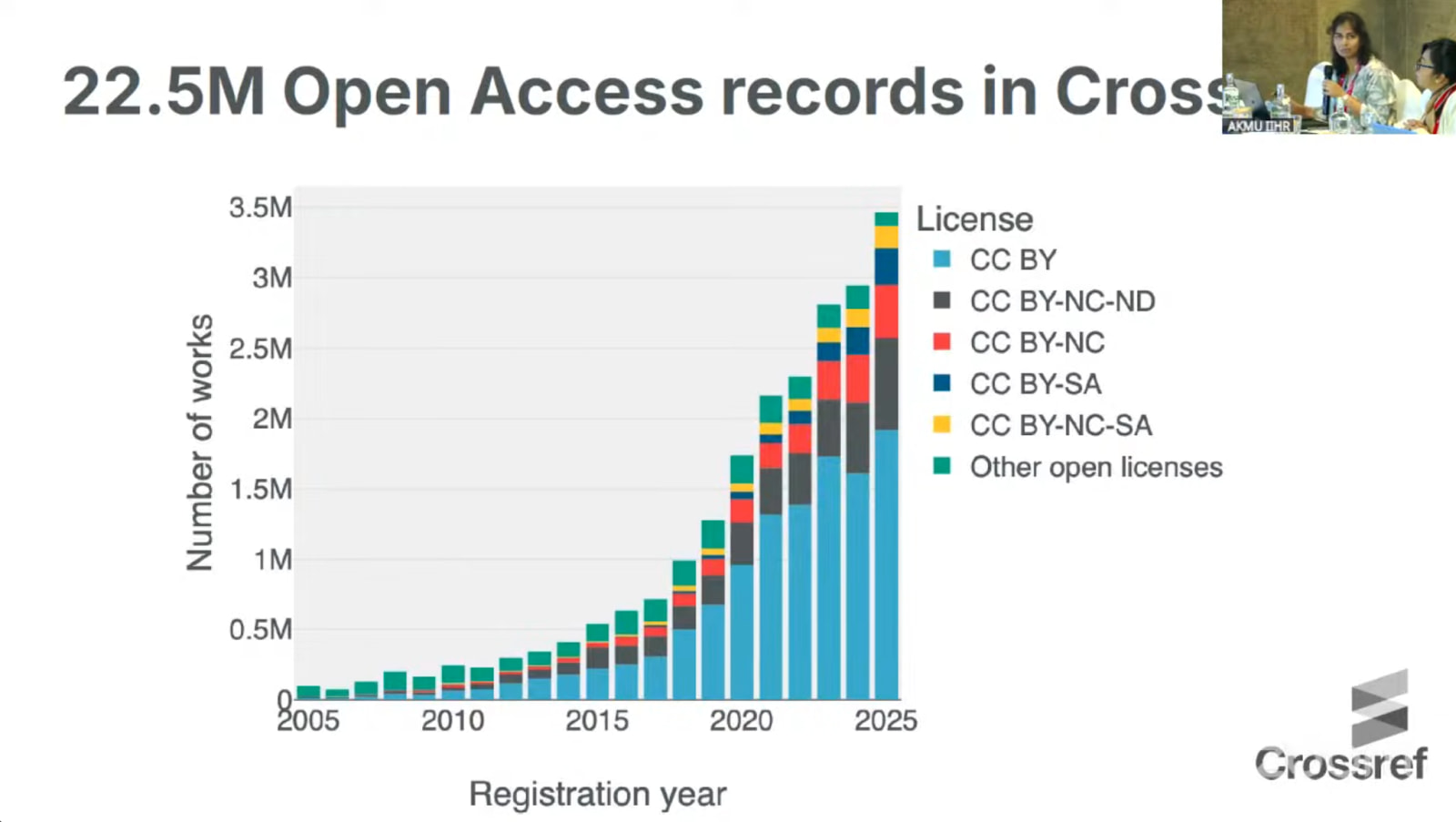
Crossref is well embedded within the Diamond OA community, since many of our members are Diamond OA publishers (anecdotally – we don’t record business models of our members), and it was great to hear from a number of partners supporting the movement. I’ll give a shout to just a handful, as there were too many to list all.
PKP – whose open-source and free software, OJS, is the primary publishing platform for this community. Our current collaboration on supporting the community to transition to their latest supported version will help enable many of these publishers to capture and register richer metadata.
DOAJ, with whom we have a long history of working together to support education of budding publishers with key industry know-how, and whose assessment process and experience proves essential for supporting trust in and among the Diamond OA publishers.
AmeliCA/Redalyc – who have rich experience in enabling Diamond OA publishing in LatinAmerica and now beyond, and who joined Crossref Sponsors program to increase opportunities for Latin American Diamond OA organisations to join Crossref.
WACREN, who’ve only just joined as Crossref Sponsor earlier this year, and who shared their experience in providing infrastructure and capacity for research communications in West Africa.
Relawan, who talked about their rich experience of building capacity for research communication and publishing in Indonesia on a breathtaking scale, and calling on the Diamond OA community at the Summit to give due attention that the movement needs to pay to research and publication integrity.
It wouldn’t be fair not to mention a number of challenges for Crossref raised in the course of the event too – including that of cost, as well as broadening representation in governance, which we are cognizant of and actively working towards reviewing our options in those areas.
Involvement of institutions and research funders is essential for the success of this publishing model, as at the end of the day - communicating research effectively comes with a cost, and the movement towards opening knowledge as public good without any fees for authors of readers implies that this cost need to be covered by other actors in the ecosystem. Accordingly, funders as well as policy-makers have been present and involved in the Summit, sharing their experiences with supporting the movement and related infrastructure to help sustain it. Among them, Marin Dacos, National Open Science Coordinator at the French Ministry of Higher Education and Research, and the new Chair of the Crossref’s Board of Directors, spoke on the French experiences of supporting Diamond OA, which include providing ample support for international, shared infrastructures essential for the flourishing of this publishing model. While Zoe Ancion of ANR facilitated a panel discussion on Building, Supporting and Sustaining
Diamond OA Infrastructure, and Ashley Farley of Gates Foundation lead a session on Responsible Research Assessment Policies as Pathway to Diamond OA.
Interestingly, at this summit some attention was paid also to non-article outputs of the research process – many of which are already deposited or published and accessible without fees - such as preprints, open software or data, and the innovative research communications practices, including post-publication peer-review, and AI-supported knowledge graphs. The Early-Career Researchers’ Panel on Day 4 of the summit spoke with a strong voice of the urgent need to recognise these outputs in research assessment (and I shared my notes on that live before).
Finally, the draft Bengaluru Roadmap was presented to the community. It’s based on the discussions across all the sessions of the summit, and in some dedicated stakeholders’ meetings that were held during the summit. It’s supposed to be a living document, providing actionable recommendations, adaptable to regional circumstances, and evolving with the community’s experience of implementation. The Roadmap covered five key areas of focus (or work) for the community:
-
Reimagining scholarly communications for equity, inclusion, and multilingualism
-
Building, supporting, and sustaining Diamond OA infrastructures
-
Publishing platforms and Services for Diamond OA
-
Metadata standards, interoperability, and persistent identifiers
-
Responsible research assessment as a pathway to Diamond OA
Let me share the screenshot of the details of the roadmap for the metadata point, as it’s most relevant to our work with the Diamond OA community:

There was an intention expressed to include capacity building and standards development, and the role of early-career researchers in the Diamond OA movement, that haven’t been detailed in the roadmap due to the recency of these discussions (immediately before roadmap presentation), so we can expect that those points will be expanded upon in future conversations.
Further to the roadmap, a call for Governmental support for Diamond Open Access was also detailed - as a call for global commitment, governance and shared responsibility.