August’s Membership Ticket of the Month was inspired by and expands upon a discussion over at the Academia Stack Exchange forum from a few months back.
As Membership Ticket of the Month fans will know, one of the core features of Crossref’s system is the ability to transfer ownership of DOI records from one Crossref member to another without actually changing the DOI string itself. This happens frequently, as when journals change hands from one publisher to another. The result of the transfer is that the new publisher can update the metadata for the existing DOIs, allowing them to send readers to the corresponding landing pages on the new publisher’s own website, rather than on the previous publisher’s site. All of this happens behind the scenes, and the affected DOI strings do not change; only the URL they send readers to does.
You may also know that while Crossref receives the highest percentage of global DOI resolution traffic (94% at time of writing), we are not the only DOI registration agency (RA) in the world. There are eleven other active RAs across the globe; of interest to today’s discussion is our fellow RA DataCite.
It’s possible to “rehome” a DOI prefix and all of its existing DOIs from one RA to another. Rehoming a whole prefix is a more involved process than a standard Crossref member-to-member transfer of DOIs. It involves coordination between both the transferring and receiving RAs, as well as the respective members on both sides. However, the result of a rehoming is that a DOI previously registered with one RA is successfully reregistered with the new RA and is henceforth managed on the new RA’s side. Again, this all takes place behind the scenes and anyone accessing a rehomed DOI wouldn’t necessarily notice any change.
With all of this preamble established (I promise it’s all relevant!), let’s now talk about Zenodo DOIs.
Zenodo is a European research repository accessible to readers and contributors around the world. Scholars and institutions host materials of all sorts on Zenodo, including datasets, presentations, journal articles, strings of code, images, and all manner of other scholarly objects. Crossref, for example, posts many of our public presentations and conference posters to Zenodo.
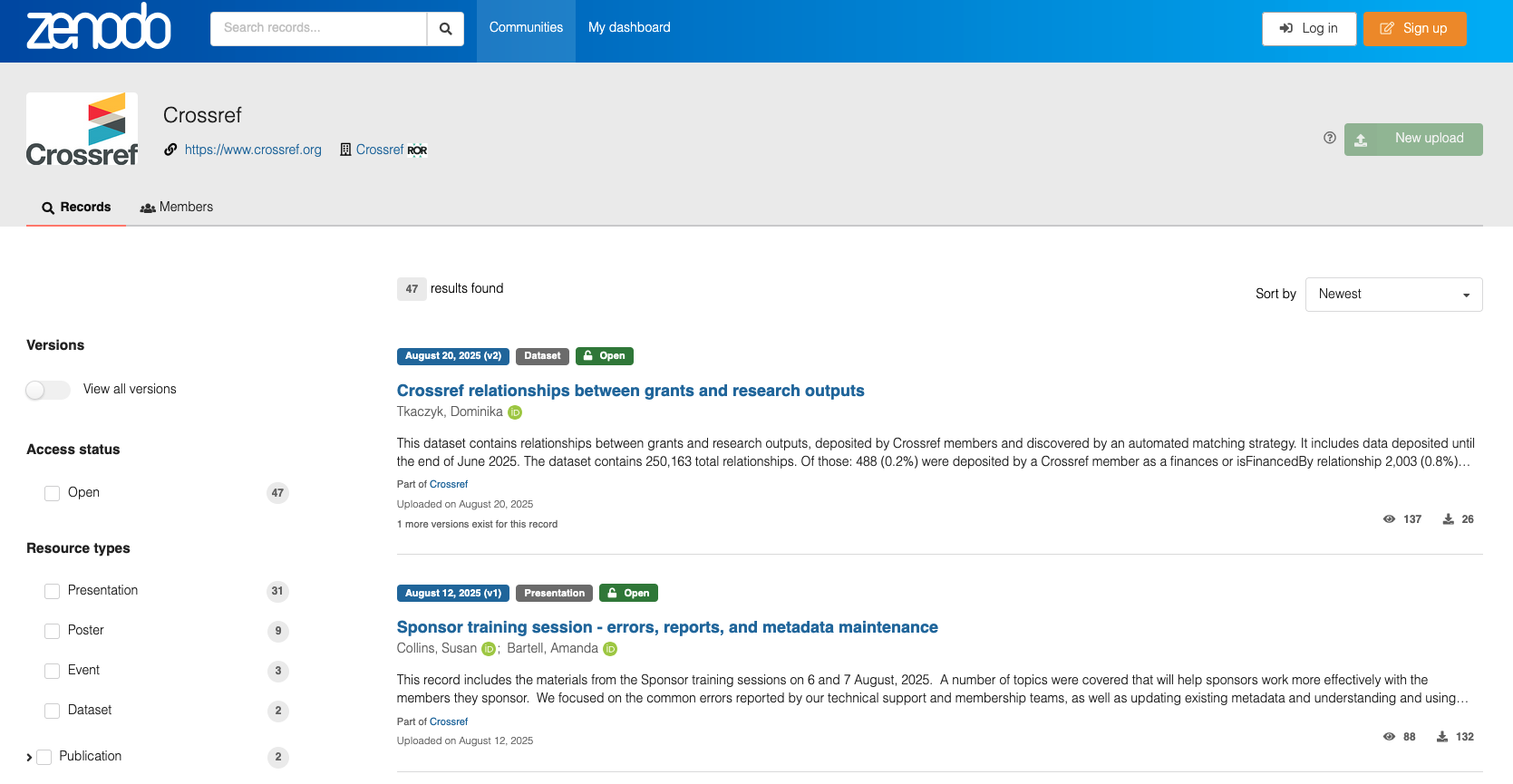
If your organization is already working with a registration agency and has your own DOI prefix, you can assign your own DOIs on your own DOI prefix to the content you host on Zenodo (see the notes at the end of this post for more details). But if you don’t have your own DOI prefix, Zenodo will automatically assign a DOI on their own prefix, 10.5281, to each work hosted in the repository. Zenodo does not charge users to register these DOIs and they assign a new DOI for each version of an object uploaded to the repository. Linked relationships between versions are indicated within the metadata that Zenodo deposits for each DOI they register.
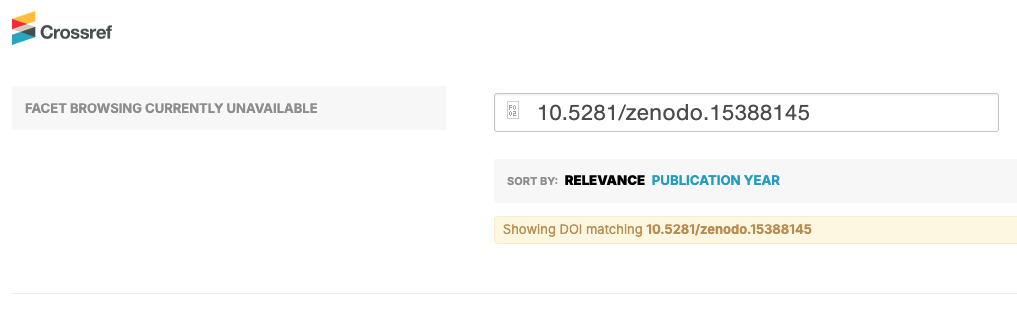
To be clear, Zenodo DOIs are not Crossref DOIs. The Zenodo DOI prefix 10.5281 belongs to the RA DataCite. If you search for a Zenodo DOI in Crossref’s system, you won’t find any of its metadata, and Zenodo DOIs are not tracked within Crossref citation metrics.
As hundreds of different organizations and tens of thousands of individual users share this one Zenodo prefix, it isn’t possible to rehome that Zenodo prefix from DataCite to Crossref. And it also isn’t currently possible to rehome just a selection of DOI records on a prefix from one RA to another.
So where does that leave you?
If you’re a publisher who has already registered some DOIs via Zenodo, you have a few options when joining Crossref.
- If your existing materials will continue to be hosted via Zenodo and you don’t need metadata about your backfile content to appear within Crossref’s systems then you may simply join us and begin registering DOIs for newly published articles going forward on your Crossref prefix. Odonatologica is an example of a journal that has done just this: through volume 49(1-2) they use Zenodo DOIs, while volumes 49(3-4) and later use Crossref DOIs.
- If you will be migrating your materials away from Zenodo onto your own domain, you can register new DOIs on your Crossref prefix for backfile contents, even if Zenodo previously assigned DOIs to those materials.
Which of these options is right for you? The relevant question to ask here is: what is the value of a DOI to your publications, authors, editors, and audiences?
If it is important for your materials to be findable among the 170 million+ other records in Crossref’s databases, or if it’s useful that citations to and from your publications be tracked and counted by our system then you will want to join Crossref and register Crossref DOIs for all your published content. Likewise, if you wish for greater control over where your DOIs send readers, you will want to become a member with us (as Zenodo DOIs can only lead to Zenodo’s own site, rather than an external domain such as an OJS- or WordPress-hosted journal site). Conversely, this article by O’Donnell et al. lays out a case of a precarious journal using Zenodo not just for the registration of DOIs but also as a hosting tool. Indeed, Zenodo is a large and stable platform which may be of use to your organization depending on your situation.
In any case, we encourage you to get in touch with our Membership team to further explore your options.
I’ll close this Membership Ticket of the Month with a few miscellaneous notes and thoughts about Zenodo DOIs that didn’t quite fit elsewhere:
- As I alluded to above, it is possible to use Zenodo as a platform in tandem with Crossref DOI prefixes. When you post materials to Zenodo, you have the option to include an existing DOI prefix within the metadata and this prefix can be a Crossref prefix. Consider this Crossref-posted dataset which has the DOI https://doi.org/10.13003/aexidu9f. 10.13003 is a Crossref DOI prefix and this DOI appears within Crossref’s system. When resolved, it leads readers to the Zenodo landing page for the dataset. However, be warned you will need to deposit the metadata for these DOI separately; this is not automatically done through Zenodo.
- If you use a hosting platform like OJS, you can certainly integrate Zenodo DOIs into the platform so they display on the material’s landing page. However, there are two caveats here: 1) these DOIs won’t be able to point readers back to the landing they’re displayed on, as seen in the Odonatologica vol. 49(1-2) examples mentioned above. And 2) if your platform automatically assigns DOIs, it’s important that you not let it assign nonexistent DOIs on the 10.5281 prefix. Zenodo DOIs are systematically assigned by the Zenodo platform with the structure 10.5281/zenodo.#######. Any attempts to assign any kind of custom DOI suffix on the 10.5281 prefix will result in a DOI that cannot be registered (e.g., 10.5281/1234567 or 10.5281/vol.4.no.2.p.376).
- Zenodo is the largest but certainly not the only repository whose DataCite DOIs cannot be rehomed to Crossref. Other examples include Figshare (10.6084) and Cyberleninka (10.24412) and similar guidance applies to these repositories as well.
Dying to know more about Zenodo DOIs? Let me know in the comments!